Win percentage
The share of simulated deals in which your best five-card hand finishes ahead of every active opponent. A win is counted only when you are the sole winner.
For off-table education only. No wagering, prizes, or links to poker rooms.
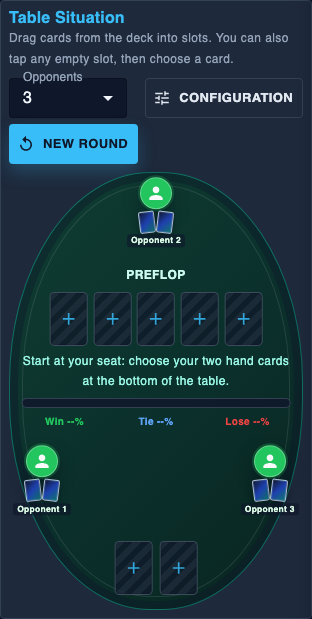
A quick look at each part of the flow. Tap any screenshot to zoom.
Pick your hole cards to start a scenario. Tap to select, tap again to clear.
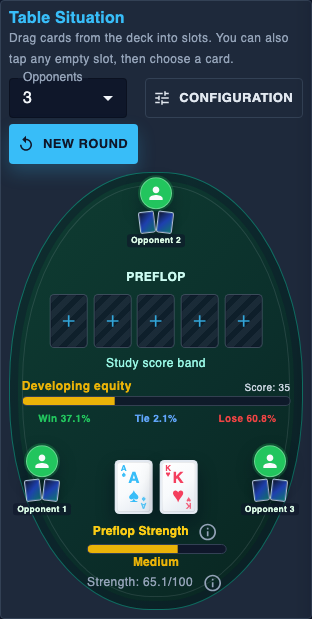
Tap to zoom
Set flop, turn and river cards for a hypothetical or completed hand.
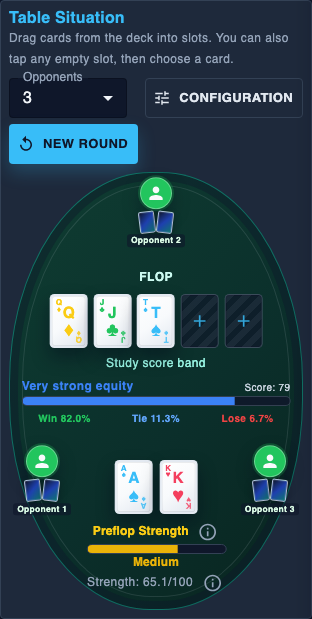
Tap to zoom
Fold opponents to mark them inactive. Folded players are excluded so statistics stay accurate.
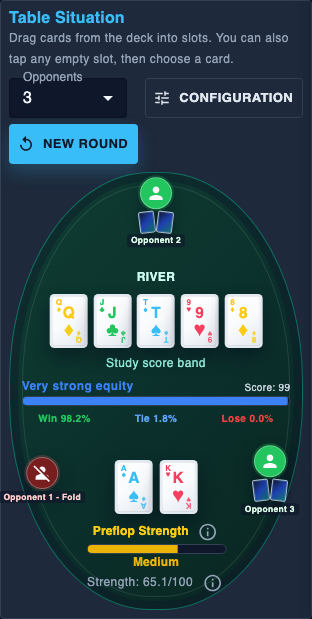
Tap to zoom
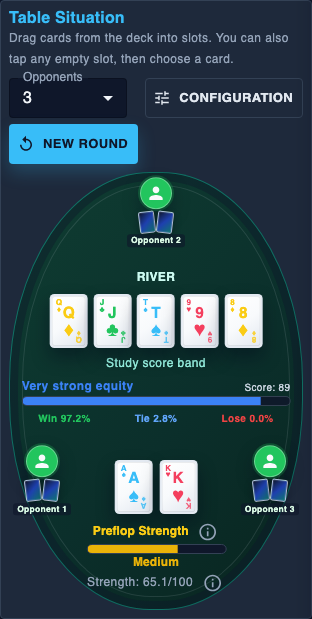
Win, tie and lose probabilities with detailed breakdowns. Updates happen in real time.
Tap to zoom
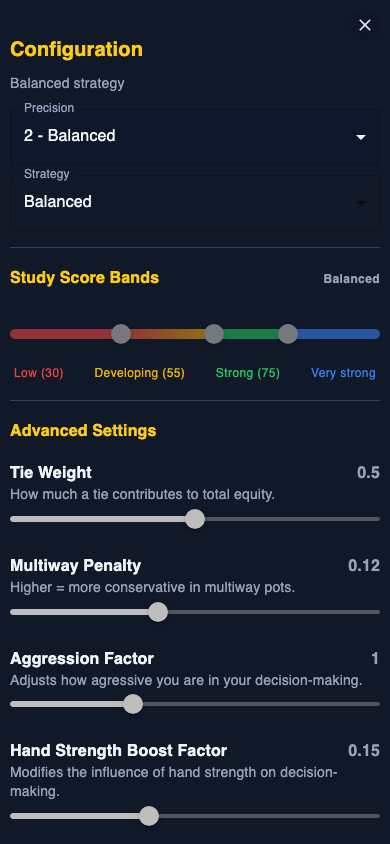
Explore how teaching-score thresholds and model sensitivity change the study output.
Tap to zoom
PokerOddz estimates how often a selected hand wins, ties, or loses across many possible deals of the unknown cards. The three percentages describe the simulated outcomes under the exact cards and opponent count you entered; they are not a prediction of the next deal.
The share of simulated deals in which your best five-card hand finishes ahead of every active opponent. A win is counted only when you are the sole winner.
The share of deals in which two or more players have the same winning five-card hand. A tie is different from a full win because the pot would be divided.
The share of deals in which at least one active opponent makes a stronger five-card hand. Win, tie, and loss should total approximately 100%, allowing for rounding.
Suppose a study reports 44% wins, 4% two-way ties, and 52% losses. Your win probability is 44%, but your estimated pot equity is 46% because you receive half of each two-way tied outcome: 44 + (4 ÷ 2). This distinction matters whenever ties are possible.
The calculator samples unknown cards without claiming to know an opponent’s private cards or personal playing range. Increasing precision runs more trials and can reduce random variation, but no simulation can guarantee a future result or include every strategic factor.
Start with the underlying mathematics. These original lessons explain what the percentages mean, how to estimate drawing odds, and how PokerOddz produces its study estimates.
Count combinations and understand why equally likely cards do not create equally likely hands.
Read lesson →Learn the exact method and the rule-of-2-and-4 shortcut—and where it breaks down.
Read lesson →PokerOddz is written and maintained by Ernani Thum. Educational claims are supported with formulas, worked examples, and a public methodology that explains the simulation process and its limitations. Calculator output is kept separate from advertising. If you find an unclear explanation or a reproducible calculation issue, send the exact cards and settings so it can be reviewed and corrected.
Instantly see your chance to win and the chance to split the pot.
Odds change a lot with more players — set opponents to match real tables.
Compare a configurable teaching heuristic and read the assumptions behind it.
You see the hand and board exactly like a poker table — great for learning.
Use the How to Play page to understand positions, rounds, actions, and hand rankings.
Runs in the browser with a responsive interface that works well on mobile.
Learn how the board affects your equity and why some hands become strong or weak.
Review completed hands and hypothetical outcomes without advanced analysis software.
Practice scenarios, compare opponent counts, and build stronger intuition.
These answers explain the calculator’s scope, assumptions, limitations, privacy choices, and responsible-use rules.
It estimates win, tie, and loss frequencies for the Texas Hold’em cards and number of active opponents you enter. It deals the remaining unknown cards repeatedly, evaluates each completed hand, and summarizes those simulated outcomes.
No. They are Monte Carlo estimates, so repeated runs can differ slightly. A higher precision setting uses more trials and generally reduces random variation, but the result is never a guarantee about the next card or a future session.
The calculator samples available cards for each active opponent after removing your cards and visible board cards. It does not know a real player’s holdings, infer behavior, or assign a custom hand range, so its output is a neutral study baseline.
Every additional active opponent receives another possible hand, creating more ways for someone to improve beyond yours. Folded opponents are excluded from the simulation, while their unknown cards remain part of the unseen deck.
It is the estimated frequency with which your best five-card hand matches another winning hand. A tie contributes only a share of the pot, which is why win probability and pot equity are not always the same number.
No. PokerOddz is intended for hypothetical examples and retrospective review of completed hands. Do not use external assistance during live play, and always follow the rules of the game, platform, and jurisdiction.
No. The site does not accept deposits or wagers, award money or prizes, run poker games, sell betting tips, or link to poker rooms and gambling operators. It is an educational probability resource.
Card choices and calculator preferences are primarily handled in your browser. The site may collect limited analytics and interaction data to diagnose problems and improve lessons. Advertising and analytics providers may use cookies where permitted; see the Privacy Policy for details and available choices.
Open the calculator and try a few hands — it’s the fastest way to build intuition.